
Currently viewing the category:
"Lesson Activities"

How many triangles can you find? Look carefully, there may be more than you think!
Click here to download a large copy of the triangle.
Click here to download a sheet to colour in your solutions.
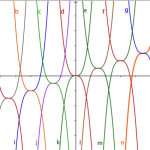
The picture shows some curves in the family of y = x cubed. Can you find the graph of this function and the equations of the other graphs? In this workshop guide you will find more examples of this type of ‘inverse problem’ where the learner is given information and has to […]

Some practical activities to help learners to tell the time on a 12 hour or 24 hour clock and to work out the lengths of time intervals.

The sum of the first 48 terms of an arithmetic series is 4 times the sum of the first 36 terms.
What is the sum of the first 30 terms?

The area of triangle PQR is 3√3 square centimetres. Angle PRQ is 60 degrees and RQ is 4 centimetres longer than PR.
Find the length of PQ.
Draw ΔPQR accurately.
Calculate all the angles in the triangle.
Click here for the Notes for Teachers.
Click here for […]

The rectangles shown are the same area. Find the area.
Make up some similar questions of your own.
Click here for the Notes for Teachers
Click here for the SAME AREA poster.

Take a sheet of A4 paper. First fold the top left corner to meet the bottom edge and press the fold flat. Then fold the top right corner to meet the edge that you folded down.
Can you prove that the quadrilateral you have made is a kite?
Can you find the perimeter of the […]
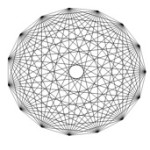
Practical activities like shaking hands, taking 2 books from a shelf and drawing the mystic rose pattern lead to understanding how to find the sum of a series and how and why different methods lead to the same result. These activities give learners the opportunity to develop logical thinking, and problem solving […]

On Monday Dolly, Kapa and Lolo cut a pizza into equal sized pieces and share the pizza in the ratio 4 : 3 : 5. This means that there were 12 pieces and Dolly ate one third, Kapa ate one quarter and Lolo ate five twelfths of the pizza.
On Tuesday they […]

The paper folding activities in this workshop guide provide experiences of discovering the properties of circles stated in seven basic theorems. Folding cut-out paper circles does not prove the theorems but it suggests recipes for the formal proofs. Teachers should do all the activities before using them in lessons even if they […]
FOLLOW US ON SOCIAL MEDIA