
Posts by: toni
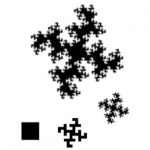
1. If the red square has area 1 square unit. What is the area enclosed by the stage 1 squareflake?
2. What is the area enclosed by the stage 2 squareflake? What about the stages 3 and 4 squareflakes?
3. If replacing each line segment on the edge with the zig-zag is […]
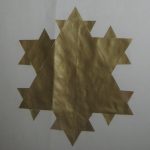
The curve, also known as the ‘snowflake curve’, was invented in 1904 by the Swedish mathematician Helge von Koch.
Take a large piece of backing paper, and either draw an equilateral triangle with edges of length 27 cm or cut a triangle from coloured paper and stick it on […]
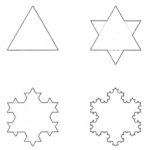
Image starting with an equilateral triangle and replacing each edge by a zig-zag curve made up of 4 pieces. Each of the 4 pieces is one third of the length of the line segment it replaces so it looks as if equilateral triangles have been attached to the shape. Now imagine repeating […]
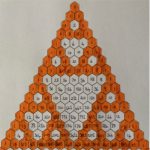
Can you see what the rule is for filling numbers in the hexagons? Continue the pattern using the same rule. If you get it right the bottom row will start 1, 9, 36, 84, …
Shade the hexagons where the number inside is odd all in one colour. Using a contrasting colour, […]
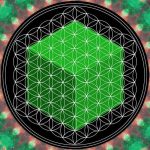
Describe the picture? What do you notice? Talk with your friends about it. What shapes can you see in it?
Describe the different symmetries. Draw the picture yourself. Draw your own designs using this idea. Can you explain how this 2-dimensional picture appears to show a 3-dimensional object?
You could use paperclip […]
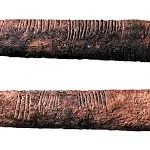
The numbers 3, 5, 7, 11, 13, 17 and 19 are prime numbers. Can you make a total of 60 from four of these numbers?
One of three columns of tally marks on The Ishango Bone gives the answer to this question. Found in the Ishango region of the Democratic Republic of […]
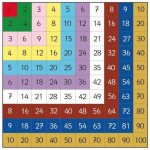
What patterns do you notice in this table?
Continue the patterns to fill the empty squares.
Write a list describing all the patterns that you see.
What do you notice about the numbers on squares of the same colour?
Would the patterns […]
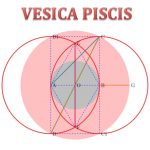
STEP 1
1a) Double click on the picture above to start the movie showing how to draw a circle using the paperclip compass.
1b) Draw 2 circles of the same radius with centres A and B so that each circle goes through the centre of the […]
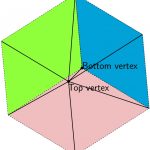
To make a model showing how cubes are made up of three square based pyramids, you will need a cardboard box, some string, some colouring pens and a knife or scissors to cut the box.
From one corner of a box cut squares all exactly the same size to form 3 faces of a cube, […]
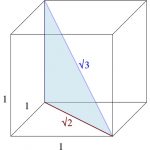
Copy this diagram. Why do the diagonals of a unit cube have lengths √2 and √3?
To draw a cube first draw a square, then draw another square the same size that looks as if it is behind the first square, then join the vertices with four parallel lines.
What are the lengths […]
FOLLOW US ON SOCIAL MEDIA