Currently viewing the tag: "Sequences"
A sequence is defined by the formula an = n2 – 2n + 1.
(a) Calculate the first 8 terms of the sequence.
(b) Calculate the first difference between the terms.
(c) Calculate the second difference between the terms.
(d) What can you say about the results you obtained?
Please click Guide for Home […]
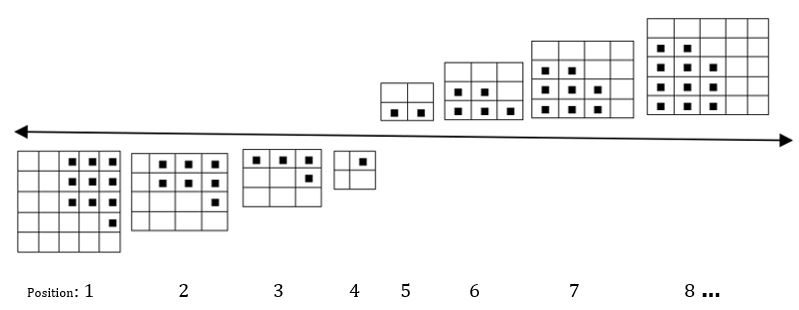
1.1 The square grids below the continuous line depict negative numbers and those above the line positive numbers. Study the square grids shown above with black squares forming a pattern. How is the pattern growing? Create square grids 9, 10 and 11; complete them with black squares to further develop the […]
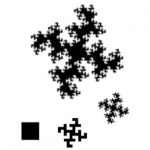
1. If the red square has area 1 square unit. What is the area enclosed by the stage 1 squareflake?
2. What is the area enclosed by the stage 2 squareflake? What about the stages 3 and 4 squareflakes?
3. If replacing each line segment on the edge with the zig-zag is […]
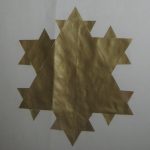
The curve, also known as the ‘snowflake curve’, was invented in 1904 by the Swedish mathematician Helge von Koch.
Take a large piece of backing paper, and either draw an equilateral triangle with edges of length 27 cm or cut a triangle from coloured paper and stick it on […]
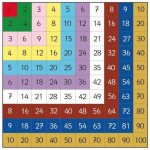
What patterns do you notice in this table?
Continue the patterns to fill the empty squares.
Write a list describing all the patterns that you see.
What do you notice about the numbers on squares of the same colour?
Would the patterns […]
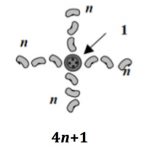
How to use beans, stones and other objects to form pattern sequences and to develop an understanding of algebraic formulas.
Click here to download a PDF with all you need to run your own professional development workshop.
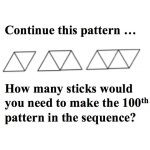
Copy this pattern. You could use toothpicks or paper sticks or draw the pattern on isometric paper (download here).
Make or draw the next 3 patterns in the sequence. How would you explain to someone else on the telephone how to do this when you could not point to the diagram?
[…]
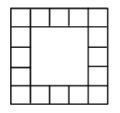
This square of squares pattern has edge length 5 squares. You could make this pattern with 48 matchsticks.
Work out the number of edge squares and the number of lines (matchsticks) needed to make the pattern with: side length 6, side length 25, side length 100, side length n.
Click here […]
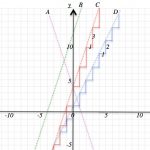
Continue these sequences for the next three terms and continue the sequences backwards to the previous 3 terms:
7, 10, 13, 16, 19, …
15, 18, 21, 24, 27, …
1, -2, -5, -8, -11, …
What do you notice?
The first two sequences come from a multiplication table shifted up. Which […]

Everyone in the class must shake hands with everyone else and say hello, or bow to each other in a one-to-one greeting. Everyone must join in. How many handshakes (or bows) will there be altogether?
This will be difficult to count, especially if you have a large class. Try the problem in […]
FOLLOW US ON SOCIAL MEDIA