
LESSON RESOURCE FOR GLOBAL MATHS AND SCIENCE LESSON 2026
Join the thousands of classes around the world in the Global Maths & Science Lesson in the week 10 – 18 October 2026. To receive a certificate of participation register at https://gtenmaths.org/gmsl and post a photo of your class taken during the lesson with hashtag #gmsl2026 .
Click here to download the detailed lesson plan. Help to set a record for the largest ever shared mathematics lesson. Numbers of participants and countries involved will be given and updated from time to time during the year.
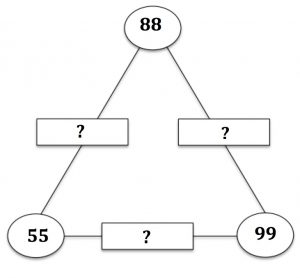 The Checkit Game is suitable for all ages because you can choose the type of numbers and the operation that you will use.
You can play this game with different sets of numbers like whole numbers or integers, fractions or decimals and with (1) addition and subtraction or with (2) multiplication and division, whichever you choose. You can play with algebraic expressions and other types of entries in the boxes.
Start with 3 entries and 3 empty boxes. The numbers on the edges of the triangle are the sum in Game 1 and the same numbers could be the product of the numbers at the vertices in Game 2.
So in this example Game 1 would have 143, 187 and 154 on the edges and Game 2 would have 4840, 8712 and 5445 on the edges.
RULES FOR THE CHECKIT GAME FOR 2 PLAYERS OR 2 TEAMS
- The players must agree on the types of entries in the boxes to be used in the game. For example the entries could be whole numbers or integers, or rational numbers, or powers of 2, 3, 4 and 7 or, for young learners, the numbers could be small, just 0 to 10 at the vertices. Or the entries could be algebraic expressions.
- The players must agree on the operations to be used in the game.
- Flip a coin to decide who goes first.
- Players take it in turns to fill in an empty box.
- Players check if the numbers entered are correct. If a player makes a mistake, and is challenged by an opponent before the opponent enters another number, then he loses the game and his opponent wins a point.
- When all 6 boxes have entries in them both players check and if there are any mistakes then both players lose a point, if everything is correct, both players win a point.
- The first player to score 5 points wins the game.
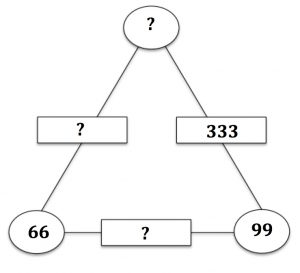 Here is another example where the operations are addition and subtraction. What numbers go in the empty boxes? Click here for the answer.
CREATE YOUR OWN CHECKIT
- Learners work in groups of four. All four learners create a Checkit puzzle. They must first agree on the type of entry and the operation. Each player draws a frame and creates a Checkit with 6 entries, then draws the frame again, filling in 3 entries and leaving 3 blanks.
- The learners then swop their puzzles with another member of the group to be checked. Errors should be corrected.
- The four puzzles are given to players in the group who have not seen them.
- Everyone solves a puzzle trying to complete all the entries in the agreed time. Then they check solutions and score 1 point for one correct entry, 2 points for 2 correct entries and 5 points for 3 correct entries.
- Play 3 rounds and the player with the highest score wins.
Click here to download the CHECKIT GAME poster.
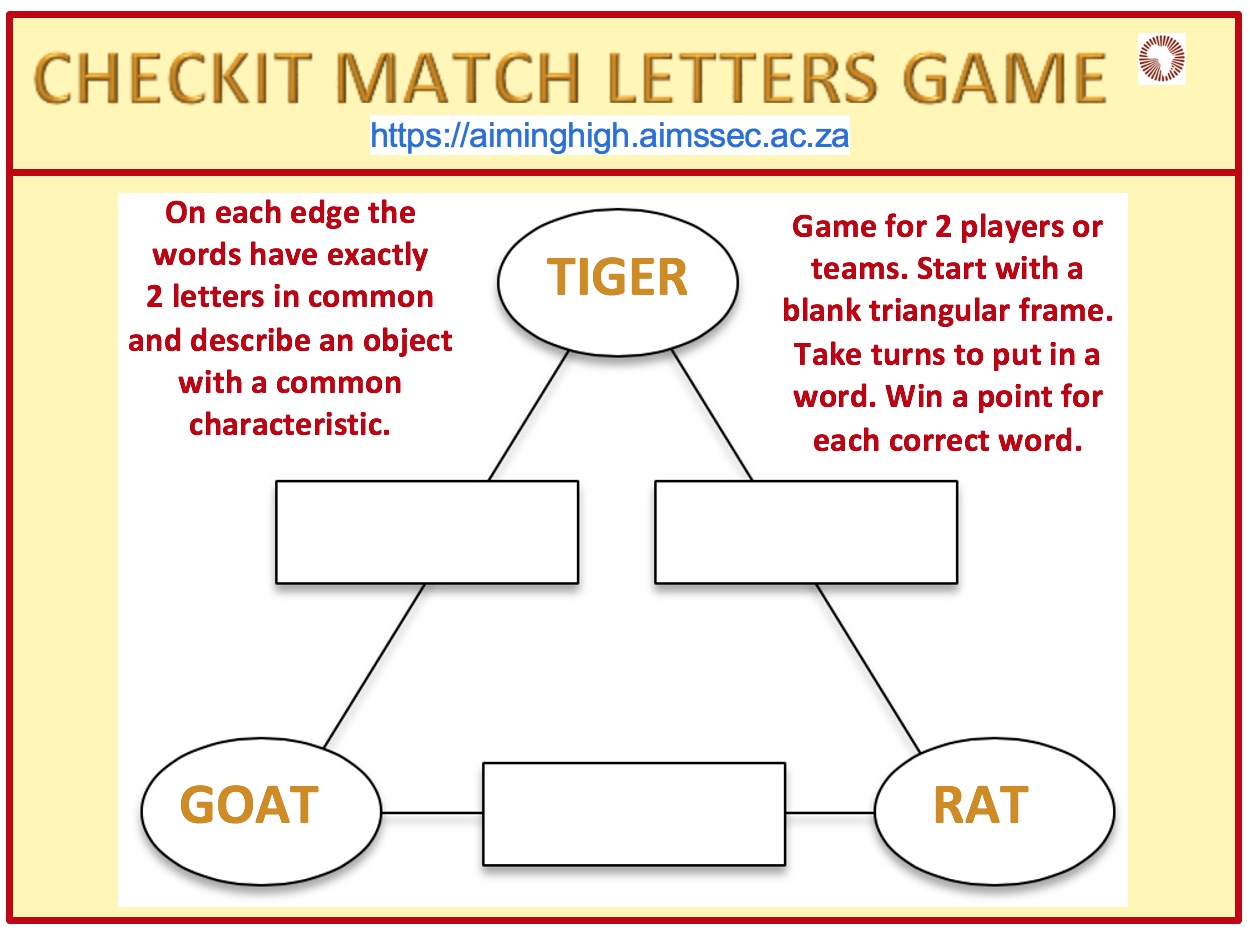
Click here to download the CHECKIT MATCH WORDS poster.
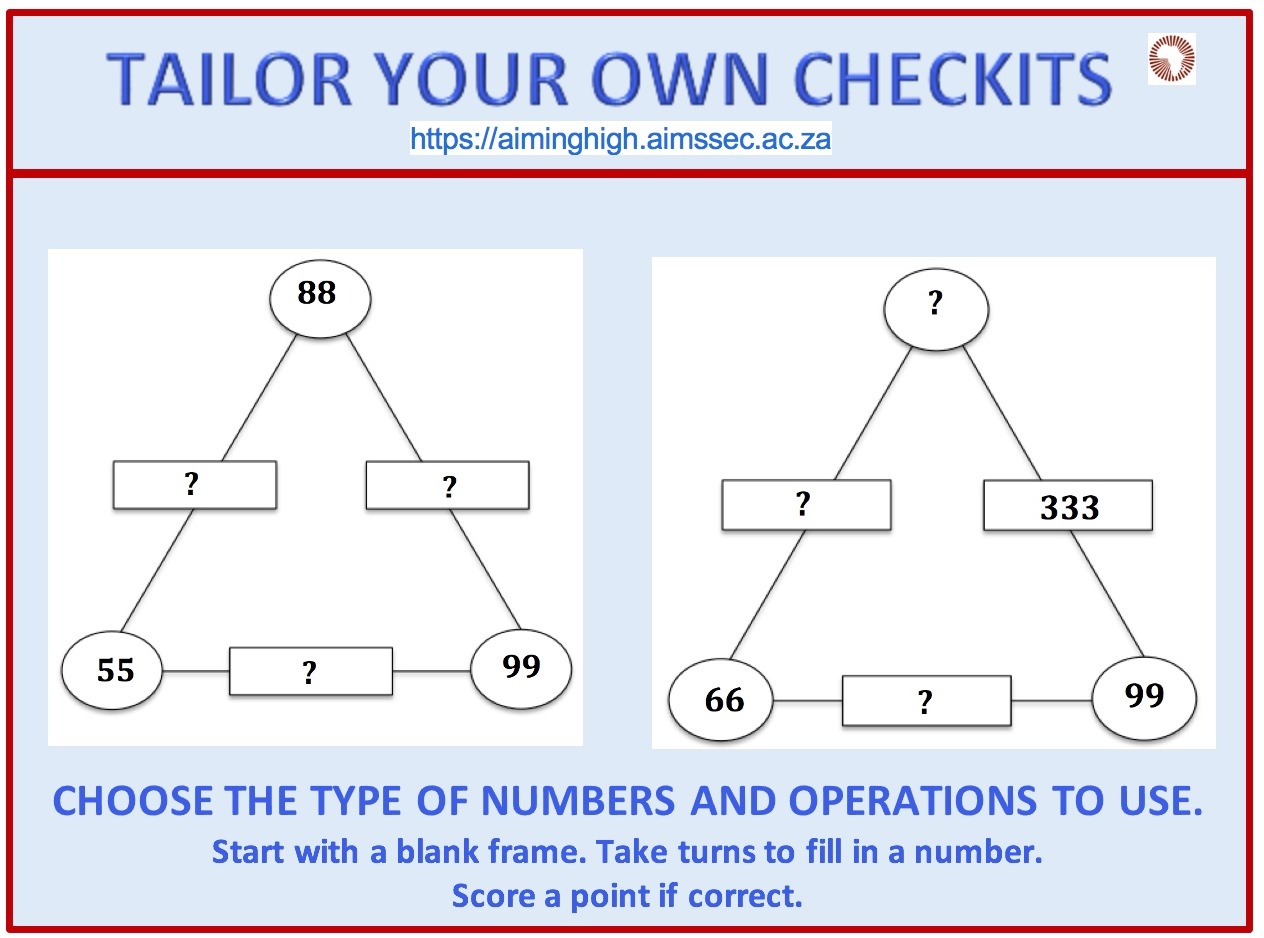
Click here to download the TAILOR YOUR OWN CHECKIT poster.
Click here to download the CHECKIT GAME worksheet.
Click here to download the CHECKIT GAME inclusion and Home Learning Guide.
Click here for the Notes for Teachers.
Click here for the AIMSSEC self help CPD workshop Guide DEVELOPING ALGEBRAIC SKILLS
What similarities and differences can you see between The Checkit Game with Addition and Polycircles https://aiminghigh.aimssec.ac.za/polycircles/ and The Triangle Midpoints Problem https://aiminghigh.aimssec.ac.za/triangle-midpoints/?
 Checkit is one of the many games in the AIMING HIGH book Let’s Play Mathematically, games designed for enjoyment and to help learners develop the transferable skills needed in employment while, at the same time, being school curriculum related.
If you enjoyed this article, please consider sharing it!


One Response to Checkit Game
Leave a Reply
You must be logged in to post a comment.
FOLLOW US ON SOCIAL MEDIA






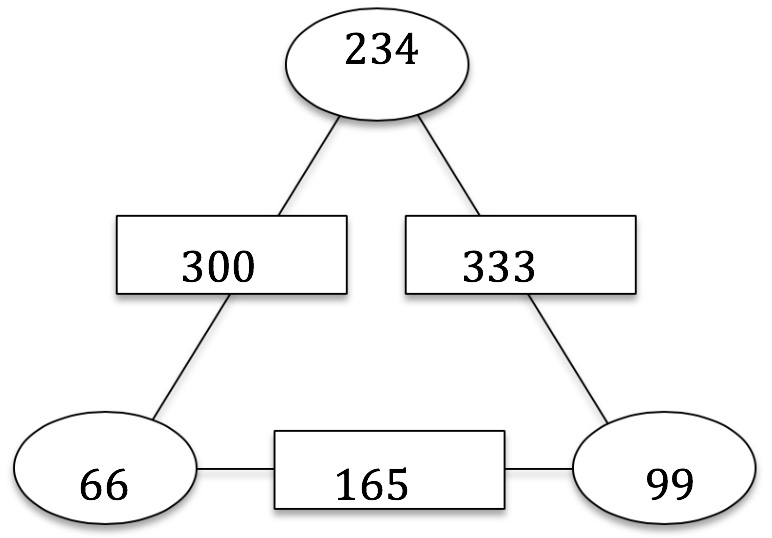
This is a fantastic game to replace lists of drill and practice exercises. We played it yesterday and even with simple numbers, so much logical thinking had to be applied as well as LOTS of calculations.
As the learners have to check each other’s results, they don’t choose the option of asking the teacher if they are right. They work so much harder of checking their own answers. A GREAT confidence builder